
Yes, you are paying way more for corrugated!
Why Corrugated Packaging Prices Keep Rising: A Look at Industry Increases, 2021–2026
For businesses that rely on corrugated boxes, price increases can feel like a recurring challenge. Just as packaging budgets settle, another supplier announcement arrives—raising questions about what is driving costs and whether there is room to negotiate.
The five complete calendar years from 2021 through 2025 , followed by additional increase announcements in 2026 , brought repeated upward pressure to the U.S. corrugated packaging market. But the story is more complicated than a steady climb. Prices rose sharply, softened as demand weakened, and then increased again—even when box demand was far from booming.
How Many Price Increases Have There Been?
A practical count is at least nine major containerboard price-increase rounds announced or taking effect across 2021–2026: two in 2021, one in 2022, two in 2024, one at the beginning of 2025, and three announced rounds in 2026.
That count refers to major pricing rounds for the paper used to manufacture corrugated packaging—not nine identical increases applied to every customer’s box purchases. It also distinguishes producer announcements from increases actually recognized by industry benchmarks.
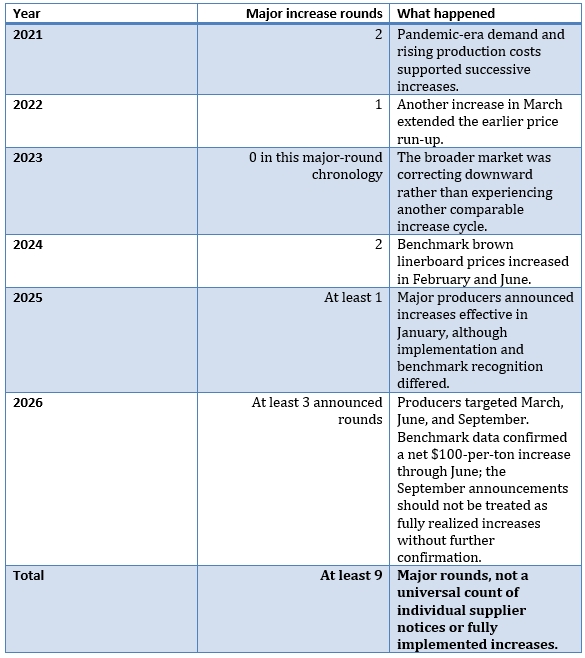
Fastmarkets’ historical reporting identifies four linerboard increases between late 2020 and March 2022, including the two 2021 rounds and the March 2022 increase. It also confirms the February and June 2024 increases. AICC’s July 2025 analysis documents the early-2025 producer increases and the disagreement over how they were reflected in industry benchmarks.
For 2026, Packaging Dive documented the March increase announcements and the second wave targeting June. Subsequent industry coverage reported a third announced round targeting September.
Importantly, adding 2026 expands this review to six calendar years, with 2026 still in progress , rather than a five-year period.
Why Have Corrugated Prices Increased?
1. The pandemic changed packaging demand.
The early part of the period was shaped by a surge in online shopping and demand for shipping boxes. Manufacturers increased production, but additional output did not immediately eliminate pricing pressure.
In June 2021, Supply Chain Dive reported that containerboard producers were operating close to full capacity while corrugated prices continued to climb.
2. Paper is only part of the cost of a box.
Corrugated packaging combines linerboard—the flat outer and inner layers—with corrugating medium, the fluted layer between them. Changes in those paper costs can flow through to finished-box pricing.
But paper is not the entire equation. Adhesives, printing inks, pallets, freight, and the costs of converting and delivering boxes also matter. Forest Packaging’s explanation of the 2021 increases describes how several of those expenses increased alongside paper prices.
This helps explain why a decline in one raw material does not necessarily translate into an equivalent reduction in the price of a finished box.
3. Later increases were not driven solely by strong demand.
One of the most important developments was the return of increases in a relatively soft market.
In 2024, Fastmarkets reported that producers sought relief from inflation and margin pressure despite mixed demand. Benchmark brown linerboard prices rose $40 per ton in February and another $40 per ton in June . Those increases followed a decline of approximately $110 per ton from the earlier market peak. Source: Fastmarkets
The lesson is straightforward: corrugated prices do not move on demand alone. Production costs, available supply, and producers’ pricing strategies also influence the market.
What Changed in 2026?
The 2026 market added another important factor: a substantial reduction in available production capacity .
Packaging Dive reported that North American producers announced shutdowns during 2025 representing nearly 10% of industry containerboard capacity , or approximately 3.9 million tons , with the final closures occurring in the first quarter of 2026.
Those reductions helped tighten supply even though demand remained mixed. Rising recovered-paper costs and other input expenses added further pressure.
The year’s pricing developments unfolded in three rounds:
· March: PCA and International Paper announced $70-per-ton containerboard increases effective March 1. Benchmark recognition occurred across March and April rather than as one immediate adjustment.
· June: Major producers announced another round, generally ranging from $50 to $70 per ton . Fastmarkets RISI recognized a $50-per-ton increase in June , bringing the benchmark’s net increase for the year to $100 per ton , after accounting for February’s decline.
· September: Subsequent coverage reported PCA’s announced $140-per-ton increase , with other producers generally announcing $80–$110 per ton , depending on the producer and material. These were announced amounts—not confirmation that the benchmark or every customer’s price rose by those amounts.
Sources: March announcements, June announcements, June benchmark results, and coverage of September announcements.
For buyers, the key takeaway is that prices can rise when supply contracts—even without a broad-based surge in box demand .
An Announced Increase Is Not the Same as a Market-Wide Increase
When a supplier announces a price increase, three different things may happen:
· The producer asks for a particular increase.
· An industry benchmark recognizes some, all, or none of that increase.
· Individual customers receive adjustments based on their contracts and negotiations.
Those outcomes do not always match.
For example, AICC reported that Packaging Corporation of America said it implemented January 2025 increases of $70 per ton on linerboard and $90 per ton on medium , while challenging the benchmark’s initial lack of adjustment.
The distinction remained important in 2026: an announced March increase was reflected in benchmark movements across multiple months, while the June benchmark recognized the full $50-per-ton increase in the targeted month.
That distinction is why counting every supplier announcement—or every month in which an index rises—can produce a misleading total.
What Can Packaging Buyers Do?
Businesses cannot control the containerboard market, but they can make price discussions more productive.
Start by asking whether a proposed adjustment reflects paper costs, converting expenses, freight, or a combination. Review how your contract handles both increases and decreases, including any timing delays.
It is also worth reviewing packaging specifications. Box dimensions, board strength, printing requirements, and order quantities are useful areas to evaluate for potential savings—without compromising product protection.
The Bottom Line
The U.S. corrugated industry experienced at least six major containerboard increase rounds across 2021–2025, followed by at least three announced rounds in 2026 . That brings this chronology to at least nine rounds across the expanded 2021–2026 period , although announcement, benchmark recognition, and customer implementation are not interchangeable.
The period included both sharp increases and meaningful declines. For buyers, the most useful question is therefore not simply, “How many increases have there been?” It is, “What changed in the market, and how should that change affect the price of our packaging?
